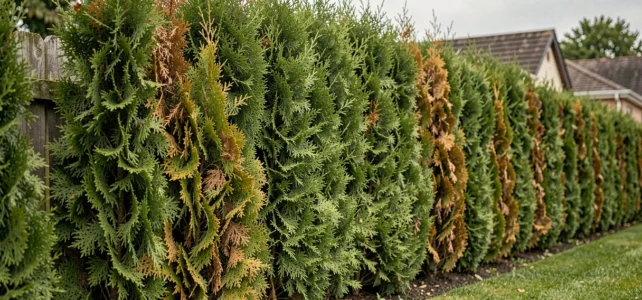
The thuja is not prohibited by national law in France. No text from the Environmental Code classifies this species among the prohibited plants on the territory. The confusion arises from local restrictions, implemented at the municipal or departmental level, which target monospecific thuja hedges for ecological, health, and regulatory reasons.
Understanding the exact nature of these restrictions, their geographical scope, and their legal foundations allows us to gauge what is myth and what is real constraint.
Local restrictions on thuja: comparative table of current regulations
| Type of restriction | Geographical scope | Legal basis | Consequence for individuals |
|---|---|---|---|
| Prefectural orders limiting planting | Several dozen departments | Forest Code, protection of wooded areas | Prohibition of planting near forests or sensitive areas |
| Municipal prohibition (e.g., Niort) | Municipal perimeter | PLU, municipal order | Obligation to choose alternative species |
| Financial aid for uprooting (e.g., Rives de Saône) | Intercommunal area | Community deliberation | Coverage of 40% of uprooting costs |
| Unique hedge regime (effective from October 1, 2026) | Metropolis | Ministerial instruction of July 17, 2026 | Regulation of destruction, modification, or pruning of any hedge |
This table highlights a fragmented regulatory landscape. There is no uniform prohibition but a layering of regulations, from prefectural to municipal, which creates a mosaic of rules varying by place of residence.
To better understand why thuja is prohibited in France in certain municipalities, it is necessary to examine the ecological and health reasons that underpin these decisions.
Impact of thuja on garden biodiversity and soils
The main criticism directed at thuja hedges concerns their effect on local fauna and flora. A monospecific thuja hedge forms a dense green wall that blocks both light and air. This evergreen foliage hardly welcomes any pollinating insects and provides neither food nor shelter for nesting birds.
The roots of thuja are particularly thirsty. In regions subjected to repeated drought episodes, this water consumption directly competes with other garden plants and surface water tables. The soils beneath a thuja hedge gradually impoverish: the acidification linked to the decomposition of fallen leaves limits the diversity of microorganisms.
The thuja buprestid, a pest that exacerbates the problem
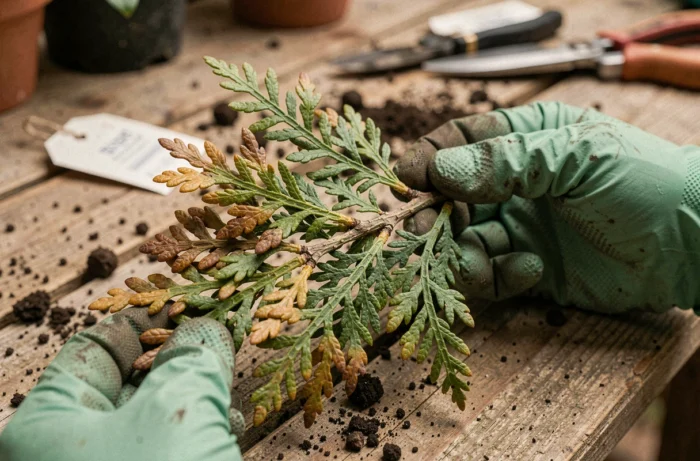
The thuja buprestid is a beetle whose larvae feed on the wood of the tree. Combined with drought, this pest causes rapid decline of hedges, even those regularly watered. Chemical treatments prove largely ineffective against this insect, leading many owners to uproot entire hedges that have turned brown and bare.
This health phenomenon reinforces the argument of municipalities that discourage the planting of thuja. A dead or dying hedge no longer fulfills its role as a visual barrier and generates significant plant waste, with no benefit to the local ecosystem.
Thuja pollen allergy: an underestimated health risk
Competitors extensively address biodiversity but often quickly overlook the health dimension. The Auvergne-Rhône-Alpes Regional Health Agency explicitly identifies thuja pollen as allergenic, alongside that of cypress, birch, or ragweed.
The ARS recommends pruning hedges before flowering to limit pollen emissions. A thuja hedge maintained late, during peak pollen season, exposes the neighborhood to an increased allergic risk. This point has a concrete regulatory translation.
Obligation to inform distributors since 2021
Since July 1, 2021, distributors of ornamental plants must inform buyers about the allergenic potential of the species sold. This legal obligation directly concerns thuja. A buyer visiting a garden center must therefore be warned of the plant’s allergenic nature before purchase.
This measure does not constitute a sales ban, but it reflects an institutional awareness of the health problem posed by certain ornamental species that are very common in French gardens.
Unique hedge regime in 2026: what changes for thuja owners
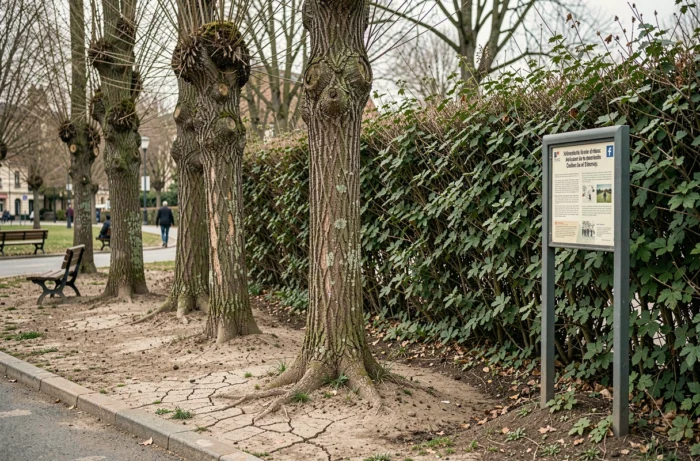
The Ministry of Ecological Transition has initiated the establishment of a unique hedge regime, set to take effect on October 1, 2026 in the metropolis. This system does not specifically target thuja but harmonizes the regulation of destruction, modification, or pruning of all hedges.
Instructions have been sent to prefects to set intervention periods and obligations for maintaining hedges in agricultural and peri-urban areas. For thuja hedge owners, this means that even uprooting or significant pruning may be subject to calendar constraints, particularly to protect bird nesting.
Alternative species recommended by municipalities
Municipalities that restrict thuja guide residents towards hedges composed of several local species. The species frequently cited in municipal documents include:
- Laurel, hornbeam, or hazel, which provide dense foliage while supporting diverse wildlife
- Field hedges mixing berry-bearing shrubs (hawthorn, elderberry, blackthorn), which feed birds in autumn and winter
- Plants with staggered flowering, which provide pollen and nectar to pollinating insects over a long period
These alternatives require different maintenance than thuja. Pruning is less frequent, but the diversity of species necessitates a minimal understanding of the growth rhythms of each plant.
The situation of thuja in France illustrates a gap between common perception and legal reality. There is no national prohibition, but heterogeneous local restrictions. The unique hedge regime, applicable from October 2026, will standardize some of the rules without banning thuja from the territory.
What weighs in the balance are the ecological and health data: soil depletion, lack of biodiversity, documented allergenic potential by the ARS. These findings are sufficient to explain the current regulatory trajectory.