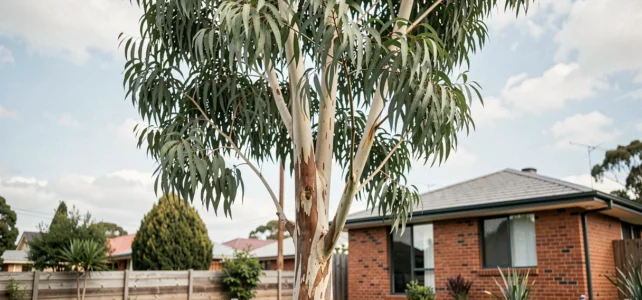
The eucalyptus planted in the garden does not protect against mosquitoes. The confusion between the ornamental tree and the repellent approved by health authorities persists in most gardening guides. We will explain why this distinction changes everything, and under what conditions lemon eucalyptus presents a real interest.
PMD and crude essential oil: two products that eucalyptus does not release alone
The active ingredient that repels mosquitoes is called p-menthane-3,8-diol (PMD). It is derived from Corymbia citriodora, the lemon eucalyptus, but it does not exist as such in the fresh leaves of the tree.
PMD is formed by hydrodistillation and then chemical transformation (acid cyclization) of the citronellal contained in the leaves. A crushed leaf releases citronellal in minute quantities, insufficient to create a repellent barrier beyond a few centimeters.
The EPA (Environmental Protection Agency) and the CDC classify lemon eucalyptus oil as a regulated pesticide whose formulation is tested. Pure essential oil of lemon eucalyptus, sold in herbal shops, does not meet the same criteria for concentration or stability. We recommend never considering these two products as interchangeable.
To better understand the benefits of the eucalyptus tree as a mosquito repellent in a comprehensive plant repulsion strategy, one must first accept that the tree alone is not enough.

Eucalyptus in the garden: what the tree provides and what it does not
An Eucalyptus gunnii or a Corymbia citriodora planted in the ground grows quickly and produces persistent foliage with a strong scent. This scent, pleasant to us, contains many terpenic compounds (citronellal, eucalyptol). The problem is quantitative.
Actual range of action of a tree in place
Volatile molecules remain concentrated within a perimeter of a few dozen centimeters around the foliage. A female mosquito in search of a blood meal detects human CO2 from several meters away. The attractive signal of CO2 overwhelmingly dominates the repellent signal of a tree located three meters from the terrace.
Crushing the leaves increases the release of citronellal, but the effect lasts only a few minutes. Comparing this fleeting exposure to a formulated spray containing stabilized PMD is like comparing a trickle of water to an integrated irrigation system.
Real interest of planting
Planting a lemon eucalyptus remains relevant for three reasons that do not pertain to direct repulsion:
- The production of leaf biomass usable in artisanal distillation, provided one has a still and masters the process of extracting citronellal.
- The localized drying of the soil due to the high water absorption of eucalyptus, which reduces micro-areas of stagnant water favorable to mosquito breeding.
- The compatibility with other repellent plants (catnip, lavender, lemon balm) in a mixed hedge aimed at accumulating volatile compounds over a narrow band.
Formulations based on PMD: criteria for choosing real protection
Since the tree alone does not protect, the question shifts to choosing the right derivative product. Not all sprays mentioning “eucalyptus” on the label are equal.
Only formulations containing refined PMD offer a duration of protection comparable to DEET. Citronella-based repellents, often highlighted, protect for about two hours. A product based on correctly dosed PMD significantly extends this protection.
Three technical criteria to check before purchase:
- The explicit mention of “p-menthane-3,8-diol” or “PMD” in the list of active substances, and not simply “essential oil of lemon eucalyptus.”
- The biocide status of the product (registration with the competent authority in France), which guarantees efficacy and skin safety testing.
- The base of the formulation (aqueous emulsion, alcoholic support), which conditions the persistence on the skin and resistance to sweating.
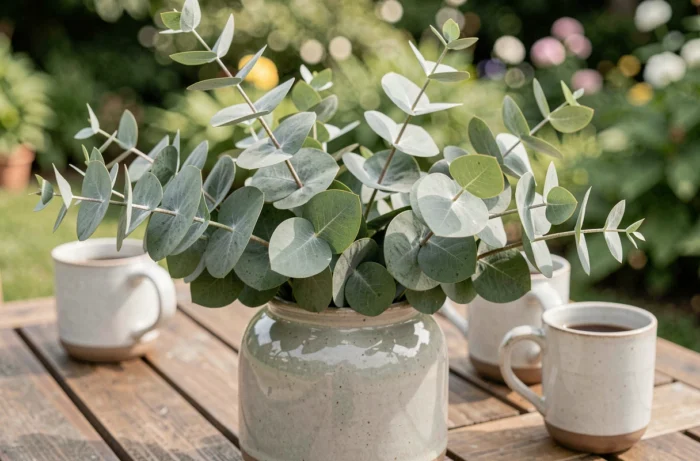
Eucalyptus globulus or Corymbia citriodora: choosing the right species
The majority of eucalyptus sold in French garden centers are Eucalyptus gunnii, appreciated for their hardiness and blue-gray foliage. This species mainly contains eucalyptol (1,8-cineole), a compound with expectorant properties but with very weak repellent effect on mosquitoes.
Corymbia citriodora, the lemon eucalyptus, produces the sought-after citronellal. Its hardiness is significantly lower: it does not tolerate prolonged frosts below -3 °C well. In oceanic or continental climates, pot cultivation with wintering under shelter remains the only viable option.
Eucalyptus globulus, the “blue gum” used in respiratory phytotherapy, is situated between the two. Its chemical profile is dominated by eucalyptol, not by citronellal. Planting a globulus in the hope of repelling mosquitoes is a botanical casting error.
Planting conditions for Corymbia citriodora
Well-drained soil, full south exposure, mandatory winter protection outside the Mediterranean zone. The tree quickly reaches several meters in height if conditions are met, which requires regular pruning to maintain a shape compatible with a medium-sized garden.
The powerful rooting of eucalyptus can compete for water with neighboring plants. We often observe dried lawns within several meters around the trunk, a side effect rarely mentioned in public planting sheets.
Relying on lemon eucalyptus as a mosquito barrier in the garden is to confuse raw material with finished product. The tree provides the starting molecule, not the protection. The only approach documented by health authorities involves PMD formulations applied to the skin or diffused in the immediate environment. Planting a Corymbia citriodora remains an interesting choice for those wishing to produce their own biomass or reduce soil moisture, but without any illusion about a spontaneous barrier effect against bites.