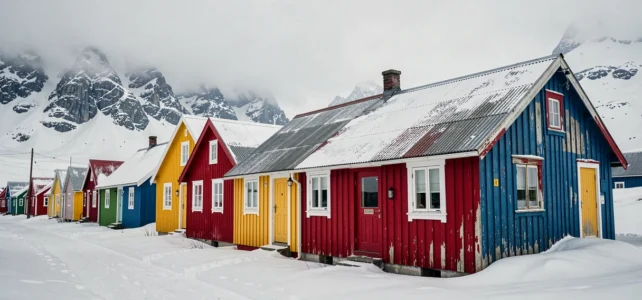
On the west coast of Greenland, the facades of the houses stand out against the white of the ice cap and the gray of the Arctic sky. Blood red, bright yellow, cobalt blue: these shades are neither random nor merely a whim. They tell a material story, that of wooden kits shipped from Scandinavia, and a functional logic, that of a color code designed to survive in a polar environment.
Scandinavian wooden kits and Danish colonization: the material origin of the colors
Before the arrival of Danish colonists, homes in Greenland were built from earth, canvas, or snow. No bright paint, no wooden facades. The built landscape blended with the terrain.
Danish colonization, which began in the early 17th century, disrupted this logic. The Danes imported prefabricated wooden construction kits from Scandinavia, a common practice in Nordic trading posts where local wood was scarce. These standardized structures arrived by ship, ready to be assembled on-site.
Paint was primarily used to protect the wood from moisture, frost, and sea salt. The pigments used, often based on linseed oil and metal oxides, produced saturated hues. Red, obtained from iron-based pigments, was among the least expensive colors, which explains its prevalence throughout the Scandinavian region.
A similar tradition can be found for Inuit dwellings in Greenland and Iceland, where the colorful facades respond to the same climatic constraints and supply chains.
What distinguishes Greenland is that these prefabricated houses remained the dominant model for centuries. The territory lacks exploitable forests. Every plank, every beam had to cross the North Atlantic. Color was therefore not a luxury: it was a protective layer applied either at the factory or at the port of arrival.
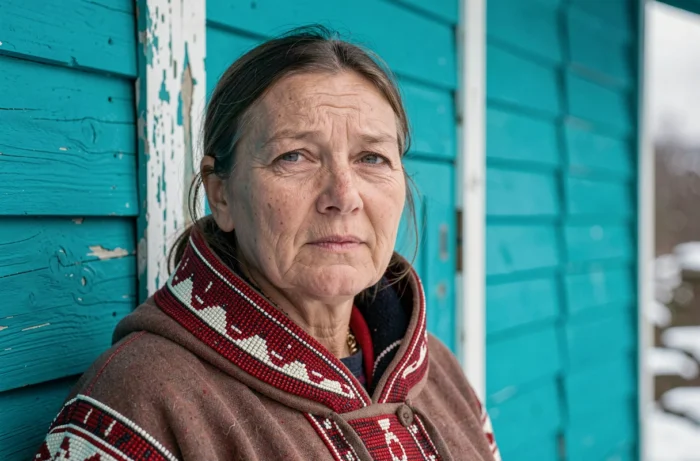
Color code of Greenlandic houses: what each shade signaled
The bright colors served more than just a protective function. They acted as a system of urban signage in towns without standardized postal addresses, where visibility could drop to just a few meters during snowstorms.
Each color corresponded to a specific function of the building or the profession of its occupant:
- Red houses indicated teachers, merchants, or administrative buildings, making them the most visible and frequented structures in the village.
- Yellow houses were reserved for medical personnel, allowing for the identification of a care center in case of emergency, even in the midst of polar night.
- Green or blue houses signaled activities related to fishing or other manual trades, depending on the locality.
- Black or dark buildings could indicate police stations or certain official functions.
This code was not uniform across the territory. From one town to another, variations existed. Field reports differ on some details: the color associated with fishing, for example, was not always the same in Nuuk and in isolated northern villages.
The logic remained the same everywhere: to identify a building by its color even before being able to read a sign. In an environment where polar night lasts for several months and blizzards erase landmarks, this visual signage had vital importance.
Contemporary evolution in Nuuk: from functional code to aesthetic choice
Today, the historical color code no longer holds regulatory value. Residents of Nuuk and other Greenlandic towns freely choose the color of their facades. Pink, purple, orange: colors absent from the original system appear on recent constructions.
This evolution does not mean that tradition has disappeared. It has transformed. Greenlanders maintain a collective awareness of the heritage of colors, and the old red or yellow houses in the historic center of Nuuk remain repainted in their original shades. The heritage coexists with more freely contemporary choices, without a sharp break.
The visual contrast with the snow remains a concrete motivation, even for new constructions. Painting one’s house white or light gray in Greenland would make it nearly invisible for several months a year. Bright hues continue to serve a practical function of readability in the Arctic landscape, even when the owner has no intention of signaling their profession.
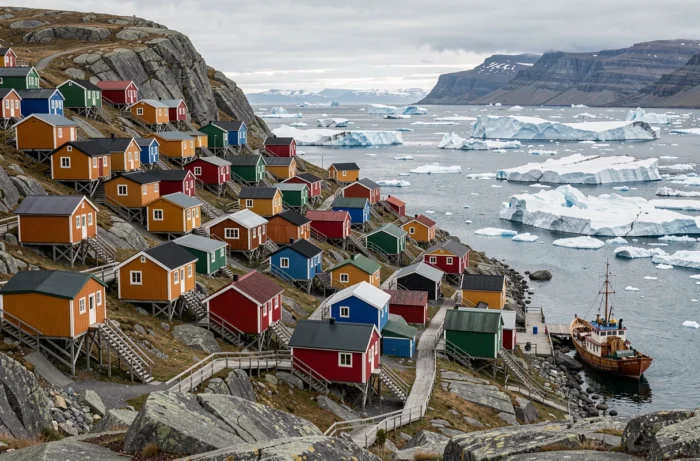
Inuit culture and Greenlandic identity: beyond Danish heritage
Reducing the colorful houses of Greenland to a mere Danish colonial heritage would be incomplete. Inuit culture has integrated and transformed this practice over generations. The colors have become a marker of local identity, an element of community pride.
In the northern villages, around the Thule region, the colorful houses contrast with the vastness of the ice cap. Each painted facade asserts a human presence in a territory where nature overwhelmingly dominates. The colors signal that someone lives here, resists the cold, and inhabits this place.
Tourism has amplified this symbolic dimension. Visitors photograph the rows of colorful houses in Nuuk or Ilulissat, and these images circulate widely. The available data does not allow for a precise measurement of the economic impact of this visual appeal, but local authorities have become aware of the heritage value of these facades.
The issue of paint supply remains current. Greenland imports almost all of its construction materials, including paint. Maintaining bright facades in a climate that deteriorates coatings within a few years represents a recurring logistical and financial effort for the residents.
The colorful houses of Greenland are therefore not a fixed decor. They result from a layering of material constraints, a polar signage system, and a cultural choice renewed with each layer of paint. As long as wood remains the dominant material and snow covers the landscape for most of the year, bright facades will remain a necessity as well as a tradition.