
The term cruelty free refers to a cosmetic product that has not involved any animal testing in its production, neither for the finished product nor for its ingredients. When applied to a retailer like Nocibé, which distributes hundreds of different brands, this label takes on a much more complex meaning than for a single manufacturer.
Nocibé distributor and private labels: a distinction to make
Nocibé is primarily a distribution network. The retailer sells third-party brands (large international groups, niche brands, organic ranges) and also offers its own lines of cosmetic products.
This dual role often creates confusion. When questioning whether nocibe cruelty free and animal testing are compatible, the answer depends on which scope we are discussing: the Nocibé private labels or the entire catalog.
For private labels, the retailer can theoretically control the manufacturing chain and exclude animal testing. For third-party brands displayed on the shelves, Nocibé does not have direct control over the practices of each supplier. Some brands distributed at Nocibé are certified cruelty free by organizations like PETA or Leaping Bunny, while others are not.
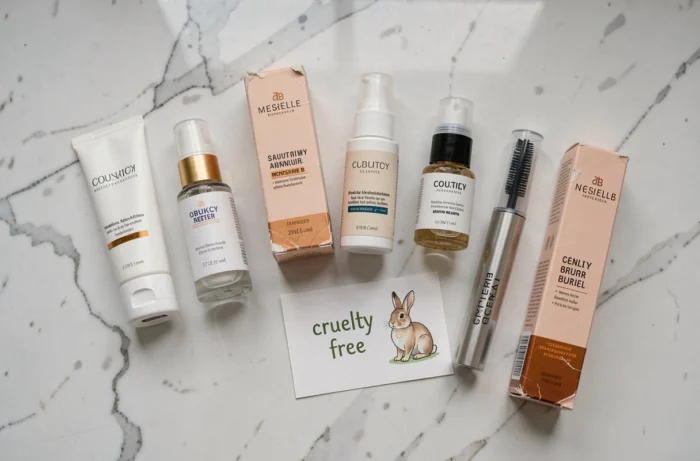
European regulation on animal testing in cosmetics: what has changed
Regulation (EC) No 1223/2009 has prohibited animal testing for cosmetic products and their ingredients marketed in the European Union since 2013. This ban covers both finished products and raw materials intended solely for cosmetic use.
This regulatory framework makes Europe a territory where, on paper, every cosmetic sold is not tested on animals. Any brand present at Nocibé and selling exclusively in the European market falls within this scope.
The issue of the Chinese market
China has long required animal testing for any imported cosmetics. Since 2021, a relaxation applies to so-called “ordinary” products (facial care, shampoos). Products classified as “special” (sunscreens, hair dyes) remain subject to animal testing obligations.
A brand distributed at Nocibé that chooses to sell in China may therefore find itself obligated to have some of its products tested on animals to access this market, even if it otherwise complies with the European ban.
REACH conflict and cosmetics: the gap that labels do not cover
This is the least addressed angle yet the most crucial for understanding the real limitations of the cruelty free label in Europe. The REACH regulation, which governs the safety of chemical substances in the EU, may require animal testing for dual-use ingredients.
An ingredient used both in a cosmetic and in an industrial product (paint, detergent, coating) falls simultaneously under the cosmetic regulation and REACH. When the European Chemicals Agency (ECHA) suspects chronic toxicity or environmental impact, it may request animal testing for the industrial part of that ingredient.
A brand can therefore claim to be cruelty free in the cosmetic sense while using ingredients tested on animals under REACH. Common cruelty free labels do not cover this gray area, as they assess the cosmetic purpose of the ingredient, not its complete regulatory journey.
European roadmap to resolve this contradiction
The EU has adopted a roadmap including over thirty recommendations to systematically integrate animal-free methods and eliminate redundant testing. The stated goal is to adapt the legislation by 2029. This initiative directly responds to the European Citizens’ Initiative “Save Cruelty Free Cosmetics.”
In the meantime, the contradiction persists: European law simultaneously prohibits and permits animal testing depending on whether one looks at the ingredient from its cosmetic face or its industrial chemical face.

Cruelty free and vegan labels: criteria to check on Nocibé products
Not all labels are created equal, and some create confusion between the absence of animal testing and the absence of animal-derived ingredients. Here are the criteria that allow for reading a certification without being misled:
- The Leaping Bunny label (Cruelty Free International) requires that the brand and all its ingredient suppliers have not conducted any animal testing, with an independent audit of the supply chain.
- The PETA “Beauty Without Bunnies” label is based on a declaration from the brand, without systematic auditing of the supplier chain. Its scope is therefore more limited.
- The vegan label means that no animal-derived ingredient is included in the formulation, but says nothing about animal testing. A product can be vegan and tested on animals.
- Organic labels (Cosmos Organic, Ecocert) do not include a specific criterion on animal testing. An organic cosmetic sold at Nocibé is not automatically cruelty free.
While browsing the Nocibé shelves, the presence or absence of these logos on the packaging remains the only reliable indicator. The retailer itself does not filter its catalog according to this criterion.
What Nocibé cannot guarantee on behalf of brands
A distributor does not have regulatory responsibility for the testing practices of its suppliers. Nocibé applies European legislation, which means that every product on the shelf complies with the 2013 ban in the EU territory.
This compliance does not cover the practices of brands in other markets, nor the REACH gray area, nor tests conducted by subcontractors of raw materials outside Europe. The answer to the initial question therefore entirely depends on the definition of “cruelty free” that one adopts.
In the strict European sense, Nocibé products are compliant. In the broader sense, including the entire global supply chain and chemical obligations, no retail brand can offer this guarantee across its entire catalog.