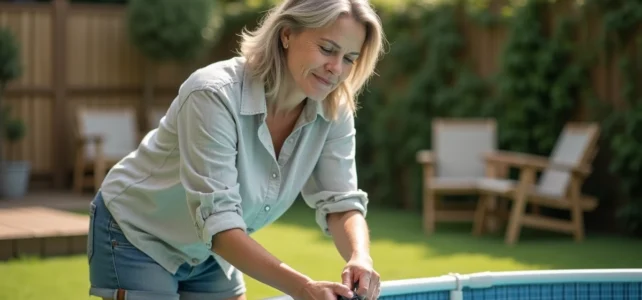
Filling an above-ground pool is not just about connecting a hose and waiting. The first hours determine the integrity of the liner, the stability of the structure, and the proper functioning of the filtration system for the entire season. Here, we detail the technical points that most guides overlook.
Above-ground pool: the invisible mistakes of the first 24 hours of filling
For a self-supporting model, smoothing out the liner folds happens within a very short window. As soon as the bottom is covered with about 10 to 15 cm of water, the folds must be smoothed out by hand, starting from the center towards the walls.
Once this stage is passed, the weight of the water presses the PVC to the ground and permanently fixes any remaining folds. A fold left in place creates a friction point that weakens the liner and promotes micro-perforations during the season.
For tubular pools, we recommend a progressive filling in stages. Fill one-third of the volume, then check the plumb of the structure with a level on the top rails. Complete the second third, and check again. This protocol detects localized settling of the ground before the mass of water turns it into a structural problem.
Another often overlooked point: the temperature of the water from the mains. Filling during a hot summer day with cold water entering a sun-heated pool causes thermal shock to the soft liner. Prefer filling late in the day or early in the morning to limit this mechanical stress on the material.
Knowing when to fill your above-ground pool with advice from Youpi La Maison allows you to anticipate these constraints right from the planning of the water filling.
Water level and skimmer: setting the optimal filling level
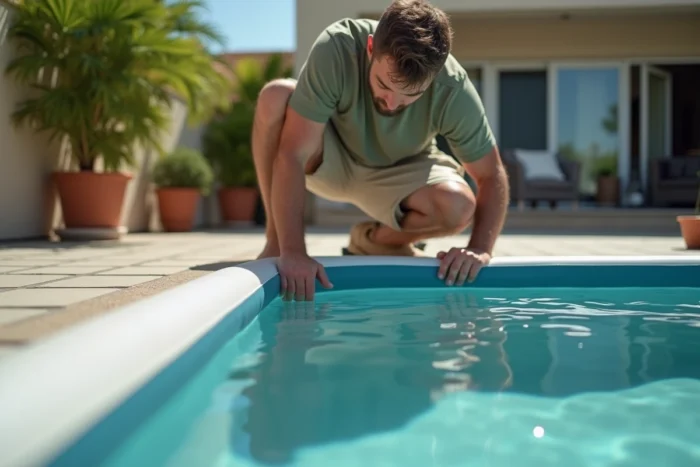
The water level should be set at half the height of the skimmer opening. Not above, not below. This rule applies to all types of above-ground pools, whether they are tubular, self-supporting, or rigid-walled.
A level that is too low causes air to be sucked into the filtration circuit. The pump loses prime, the motor runs dry, and overheats. On some models without built-in thermal protection, just a few minutes are enough to damage the mechanical seal.
A level that is too high poses the opposite problem: the skimmer can no longer capture surface impurities (leaves, insects, greasy film). Water stagnates on the surface, the waterline becomes dirty, and the chemical treatment loses effectiveness since the filtration does not properly circulate the upper layer.
Checking the level after commissioning
Natural evaporation lowers the level by several centimeters per week during hot periods. We observe that an above-ground pool without a cover loses water faster than an inground pool, due to the surface exposed to wind on the walls. Checking the level at the skimmer every two to three days remains the minimum frequency to maintain a stable filtration flow.
Filling and treatment: preparing the filtration as soon as filling begins
Filtration does not start once the pool is full. It is prepared during filling. As soon as the level reaches the skimmer, the circuit must be primed to start circulating the water. Waiting until the next day allows stagnant water to warm up without treatment, which promotes rapid development of microscopic algae.
The steps to follow in order during the first filling:
- Rinse the filter media (sand, glass, or cartridge) before the first cycle to eliminate fine manufacturing particles that could cloud the water
- Prime the pump as soon as the level covers the skimmer, by purging the air from the pre-filter via the purge plug
- Run the filtration continuously for the first 24 to 48 hours to homogenize the volume and allow the treatment to disperse
- Test the pH before adding chlorine, as an unbalanced pH drastically reduces the effectiveness of chlorine
In mains water, the pH is generally within an acceptable range, but some municipalities supply hard water that raises the pH above the comfort zone. A test with a strip or colorimetric kit is necessary as soon as filling is complete.

Water restrictions and filling above-ground pools: regulatory framework
Prefectural orders regulate the filling of pools according to four levels of drought alert: vigilance, alert, heightened alert, and crisis. During heightened alert, filling is generally prohibited, and in a crisis situation, even topping up may be restricted.
These restrictions vary from one department to another and sometimes change during the season. Checking the current order in your municipality before starting a fill is not optional. Fines for non-compliance can reach significant amounts.
Anticipating filling to avoid blockages
We recommend planning the filling as early as possible in the season, before the heat peaks that trigger restrictions. Filling in May or early June, when the water tables are still at a comfortable level, avoids the stress of a ban in July.
For pools already in service, limiting evaporation with a cover or solar blanket reduces the need for topping up. This is also the simplest way to remain compliant during restriction periods, as maintaining the existing level is often tolerated once the initial filling is done.
The regulatory framework evolves each year with the intensification of drought episodes. Consulting your prefecture’s website or the map of current restrictions before any operation on the pool remains the only reliable precaution.