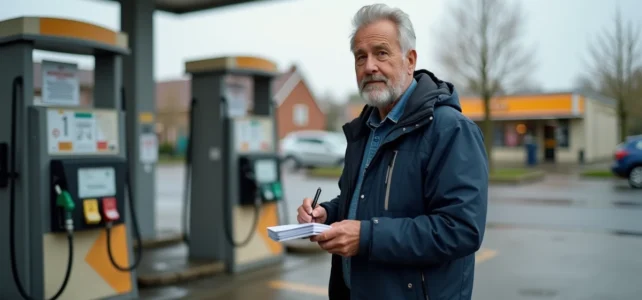
You arrive at the gas station with your tank nearly empty, and your only available payment method is a check. The automatic pump refuses anything but a credit card. The counter is closed. This situation, increasingly common, particularly affects drivers in rural areas or those whose credit card regularly causes problems.
The bank check remains a legal payment method in France. No law requires a merchant to accept it, but none prohibits it either. The difficulty lies in the commercial policy of each brand, which is rapidly evolving towards complete digitization.
Why gas station automats refuse checks
The majority of stations now operate in self-service mode, with automated payment terminals. These kiosks read credit cards and sometimes accept contactless payments or mobile applications. No automat in France processes checks.
To pay by check, you must go through a counter staffed by an employee. This counter only exists in so-called “staffed” stations, meaning those that have a shop open during service hours. The 24/7 automatic stations, which are very common on the outskirts of cities, simply do not offer this option.
The problem goes further. Even in stations with a counter, the decision to accept a check belongs to the manager or the brand. Since 2024, several large retail groups are tightening their payment policy, gradually restricting the use of checks in stores and at adjacent stations. This trend mechanically reduces the number of sales points where checks remain possible.
You can find a detailed overview of the brands still concerned about paying by check at gas stations, with the specific conditions for each network.
Large retail stations: loyalty card required, check under conditions
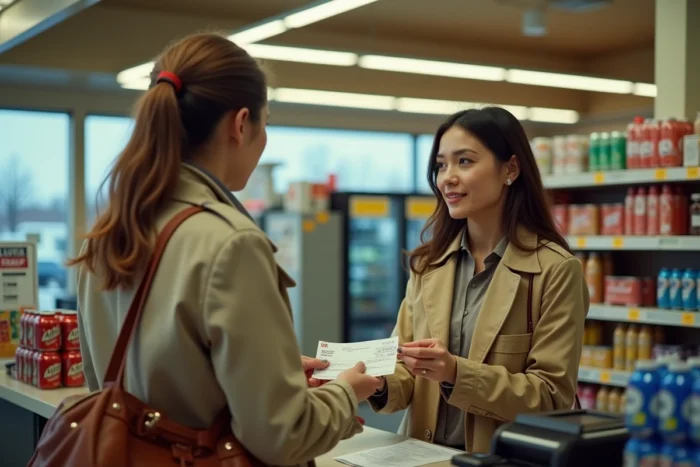
The stations attached to supermarkets (affiliated with brands like Leclerc, Intermarché, or Système U) are the most likely to still accept checks. The reason is simple: the checkout process in the store allows for payment processing, with an employee verifying the identity and the check.
In practice, several restrictions apply depending on the brand:
- A form of identification is always required, in accordance with legal verification obligations.
- A payment limit for checks is often set, varying from one brand to another (sometimes limited to a modest amount).
- Some stations refuse checks issued by companies or foreign banks, only accepting personal checks drawn on a French bank.
The policy can change from one store to another within the same brand. An Intermarché in a rural community may accept checks while one in an urban commercial area may not. There is no uniform rule.
Highway stations: a special case
Most highway stations have a counter. Checks are sometimes accepted there, but with strict conditions. Staff verify identity, and the maximum allowed amount tends to be low. During peak periods (holiday departures, long weekends), some stations temporarily suspend the acceptance of checks to streamline the checkout process.
Rural areas and independent stations: the last bastion for checks
You may have noticed that discussions on local forums or Facebook groups in rural communities regularly come back to this topic. This is no coincidence. Independent stations in rural areas remain the most tolerant towards checks.
In areas with low banking coverage, or in agricultural regions, refusing checks would mean excluding part of the clientele. Older drivers, farmers, or people whose cards are regularly declined still depend on this payment method. The managers of these stations know this and maintain the acceptance of checks out of commercial pragmatism.
The problem is that these stations do not appear on any centralized list. No official interactive map lists the sales points accepting checks. The most reliable method remains to call the station directly before going there, or to consult local groups on social networks where residents share this information.
Bank check, energy check, vacation check: do not confuse
A common confusion complicates the search for information. The classic bank check (the one from your checkbook) has nothing to do with the energy check or vacation check, which are specific aid programs.
The energy check cannot be used to pay for fuel at a station. It is intended for heating and domestic energy expenses. The vacation check, on the other hand, can sometimes be used for fuel or tolls, but only with providers affiliated with the acceptance network, which excludes the vast majority of gas stations.
When you are looking for a station that accepts “checks,” always specify that it is the bank check. The responses you receive will be very different depending on the type of check involved.
Verifications to anticipate before paying by check at a station
If you find a station that accepts checks, be prepared for a longer procedure than a simple card payment. Here’s what will be required:
- Presentation of a valid form of identification (national identity card or passport).
- Writing the check on-site, made out exactly to the station or brand.
- Compliance with any limit set by the manager, who may refuse a check above a certain amount.
- The check must be drawn on a personal account at a French bank: business or foreign checks are increasingly being refused.
A refusal of a check remains at the merchant’s discretion. Even if the brand theoretically allows it, the manager may cite doubts about solvency or a technical incident to refuse it. You have no recourse in this case.
The decline of checks at gas stations follows a broader trend driven by the digitization of payments. For drivers who depend on them, the best strategy remains to verify by phone before each trip and to prioritize stations with a counter, especially those attached to a supermarket in rural areas.