
The blue color of a swimming pool does not solely depend on chemical treatment. It results from a combination of physical and chemical factors: how light passes through the water, the presence or absence of suspended particles, and the surface condition of the pool. Achieving perfectly blue pool water requires mastering each link in this chain, from the bottom of the pool to the surface film.
Why pool water appears blue: the role of light absorption
Pure water absorbs more of the red and orange wavelengths of the visible spectrum. As depth increases, the warm hues disappear and blue predominates. A shallow pool will therefore appear less blue than a deep pool, even with identical treatment.
This optical phenomenon explains why the color of the lining plays a crucial role. A light gray or white liner enhances the reflection of blue light, while a sand or beige covering shifts the appearance towards green. The choice of lining determines the perceived shade even before the first liter of product is added.
Suspended particles (microscopic algae, dust, sunscreen residues) scatter light in all directions, which clouds the water and breaks the blue dominance. To delve deeper, the techniques of Maisons Euro France help understand how each parameter influences the final shade of the pool.
Chemical balance of water: pH, TAC, and free chlorine
Three chemical parameters determine the clarity of the water, and thus its ability to reflect blue.
pH, the central parameter of color
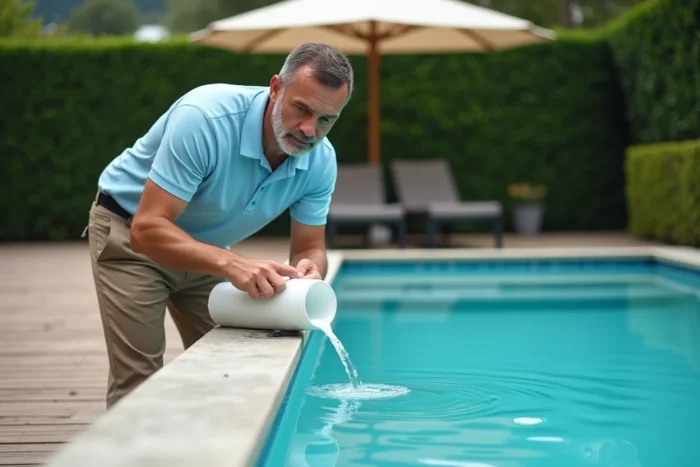
A pH maintained between 7.2 and 7.4 ensures the effectiveness of the disinfectant and limits the formation of colloidal particles that cloud the water. Above 7.6, chlorine loses much of its oxidizing power. The water gradually becomes milky, then greenish if algae settle in.
Measuring the pH twice a week with strips or a photometer remains the most cost-effective action to preserve the blue color. A drifting pH is not visible to the naked eye for several days, but damage to water quality is already underway.
TAC and hardness: the forgotten stabilizers
The total alkalinity (TAC) acts as a buffer that prevents the pH from fluctuating sharply after a rain or an influx of swimmers. A TAC that is too low makes the pH unstable, while a TAC that is too high promotes the formation of limescale deposits that whiten the walls and scatter light.
The hardness of the water (TH) acts similarly. Very hard water leaves a film on the lining and surface, which dulls the blue shade. In areas where the network water is hard, a specific anti-limescale treatment is necessary from the moment of filling.
Filtration and circulation: the mechanical foundation of blue water
Chemical treatment cannot do anything if the filtration system does not remove physical particles. The quality of filtration depends on three elements that work together.
- The daily filtration time, which must cover at least the entire volume of the pool. During hot periods, doubling this time prevents peaks of turbidity related to bacterial proliferation.
- The condition of the filtering medium (sand, glass, cartridge). A clogged sand filter or a dirty cartridge allows fine particles to pass through that remain suspended and cloud the water.
- The water level in the skimmer, often overlooked. If the water drops below half of the skimmer opening, it draws in air instead of capturing the surface film. Greasy substances, pollen, and debris then remain on the surface and alter the perceived color.
Recent installations incorporate more efficient filtering media (recycled glass, zeolite) and filtration times adapted to usage. These systems maintain clearer water while limiting peaks of free chlorine and skin irritations.
Surface grease film: the invisible cause of dull water
Sunscreens, body oils, and sebum form a surface film that breaks light reflection. This greasy film is the primary cause of water that appears “acceptable in the chemical test” but visually disappointing.
Placing one or two clean tennis balls in the skimmers helps capture some of these greasy substances. The felt of the ball absorbs oils throughout the day. This simple action, documented by pool professionals, reduces the greasy film without adding chemical products.
Combined with weekly filter cleaning and a nighttime cover that limits debris input and evaporation, this method contributes to restoring a “mirror blue” effect on the surface. The nighttime cover has a dual benefit: it reduces temperature drop (which slows disinfectant consumption) and prevents leaves, insects, and pollen from contaminating the water during non-filtration hours.
Sun exposure and temperature: two accelerators of degradation
UV rays degrade free chlorine. With strong exposure, the concentration of disinfectant can drop by half in a few hours. The water remains apparently blue in the morning, then turns cloudy by late afternoon. A stabilizer (cyanuric acid) protects chlorine from photodecomposition, but its dosage must remain moderate: in excess, it blocks the action of chlorine and causes the opposite effect.
The water temperature amplifies the problem. The warmer the water, the faster microorganisms multiply and the quicker chlorine depletes. During heatwaves, increasing filtration time and checking pH daily becomes the only viable solution to maintain a stable blue color.
A pool cover or shade sail reduces direct UV exposure while limiting evaporation. This physical protection complements the chemical stabilizer and extends the duration during which the water retains its clarity.
The blue color of a swimming pool relies on a balance between optics, chemistry, and mechanics. An appropriate lining lays the foundation, a stable pH around 7.3 ensures treatment effectiveness, and properly sized filtration removes what chemicals cannot dissolve. The surface grease film, often ignored, makes the difference between “clean” water and truly blue water.