Road freight transport in France is entering an unprecedented phase of regulatory and technological transformation. The decarbonization trajectories imposed on new heavy goods vehicles, the tightening of sanctions on GHG reporting, and the emergence of AI in fleet management are reshaping the hierarchy among the main French transporters.
CO₂ Regulatory Constraints on New Heavy Goods Vehicles and Fleet Renewal
The European regulation that came into effect on July 1, 2024, sets a trajectory for reducing CO₂ emissions from new heavy-duty vehicles compared to the 2019 reference. The thresholds are clear: 15% reduction by 2025-2029, 45% by 2030-2034, 65% by 2035-2039, and 90% starting from 2040. For the top 100 road transporters, these thresholds directly condition the truck purchasing strategy for the next 10 to 15 years.
We observe that large groups renewing several hundred vehicles per year are already integrating these thresholds into their investment plans. Those who delay risk ending up with depreciated assets and penalties in tenders, where carbon criteria weigh increasingly heavily against just the price per kilometer.
The question of the alternative energy mix (electric batteries, hydrogen, B100, bioGNV) remains open. No single powertrain currently covers all use cases, from urban last-mile delivery to long-distance transport. The transporters listed in the list of French road transporters are making choices between these technologies based on their route profiles, access to charging infrastructure, and manufacturers’ delivery times.
Sanctions on GHG Reporting: What Changes Effectively from 2025
Decree No. 2017-639 already required any transport organizer to inform its clients about the greenhouse gas emissions of each service. The new development is that effective financial sanctions will apply starting January 1, 2025, with fines of up to 3,000 euros per violation.
For companies in the top 100, this unit amount seems modest. The real risk is reputational and commercial. An industrial shipper auditing its logistics providers will dismiss a transporter unable to provide reliable and traceable GHG data. The greenhouse gas emissions report (BEGES) has become a reference document in contractual negotiations, on par with quality certifications.
The best-positioned players have automated carbon data collection through their TMS (Transport Management System), with inputs by route, by client, and by vehicle type. Others are still compiling quarterly spreadsheets, exposing them to reporting errors and timelines incompatible with the requirements of clients.
AI and Autonomous Agents in Fleet Operational Management
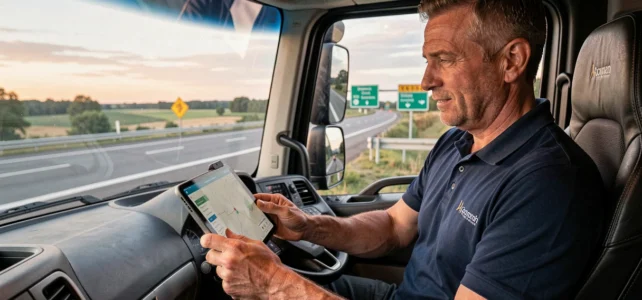
The digitalization of fleets has reached a new level with the emergence of AI agents capable of simultaneously handling route optimization, available freight management, and predictive maintenance. Trimble, for example, is betting on a unique AI agent to streamline transport operations, consolidating previously scattered data into a single interface.
This type of tool alters the daily decision-making chain:
- Vehicle assignments take real-time account of load levels, average consumption per axle, and traffic restrictions related to low emission zones (LEZ).
- Freight marketplaces diversify access to loads and help reduce the rate of empty kilometers, a key profitability indicator for any road transporter.
- Predictive maintenance, powered by onboard sensors, anticipates breakdowns and reduces unplanned downtimes, a cost item that fleets of several hundred trucks seek to compress.
We recommend not evaluating these solutions solely based on their technological promise. The return on investment depends on the quality of input data: onboard telematics, consumption history, mapping of delivery points. A transporter with a fragmented information system will only exploit a fraction of the potential of these tools.

Green Certificates and Fuel Mix: Distinguishing Real Commitment from Window Dressing
The market for green certificates applied to transport is generating increasing interest among the top 100 French transporters, but also heightened vigilance. The line between effective decarbonization and greenwashing remains thin when a certificate does not correspond to a measurable reduction in the transporter’s operational chain.
The fuel mix represents a more tangible lever. HVO (hydrotreated vegetable oil), B100, and bioGNV allow for significant emission reductions in existing fleets, without waiting for a complete fleet renewal. Energy savings certificates (CEE) in the transport sector provide a complementary financing mechanism to support this transition.
The challenge for logistics departments selecting their providers from the ranking of road transporters is to verify the consistency between stated commitments and actual operational data. A transporter that communicates about carbon neutrality without being able to detail its energy mix by transport line faces an increasing credibility risk.
TIRUERT and Traceability of Renewable Energies in Transport
The incentive tax related to the use of renewable energy in transport (TIRUERT) now includes new traceability rules for hydrogen and electric charging. These developments require transporters to precisely document the origin of the energy consumed by their decarbonized vehicles.
For fleets investing in electric or hydrogen trucks, this traceability becomes a competitive advantage. It allows them to demonstrate to shippers a verifiable decarbonization and not just a declarative one. The top 100 transporters that master this proof chain differentiate themselves in tenders where the environmental criterion weighs alongside price and delivery time.
The French road transport sector is no longer just a competition based on volumes and rates. The ability to integrate carbon regulatory constraints, leverage operational AI, and prove the reality of environmental commitments now determines each player’s position in the hierarchy of major transporters.