
Article 671 of the Civil Code sets the framework: any planting exceeding 2 meters in height must be located at least 2 meters from the property line. Below 2 meters, the minimum distance drops to 50 centimeters. Bamboo, legally classified as a tree, fully falls under these provisions. However, it is the spreading nature of its rhizomes that turns a question of distance into a real issue of civil liability.
Spreading Rhizomes and Encroachment: The Legal Framework That Gardeners Underestimate
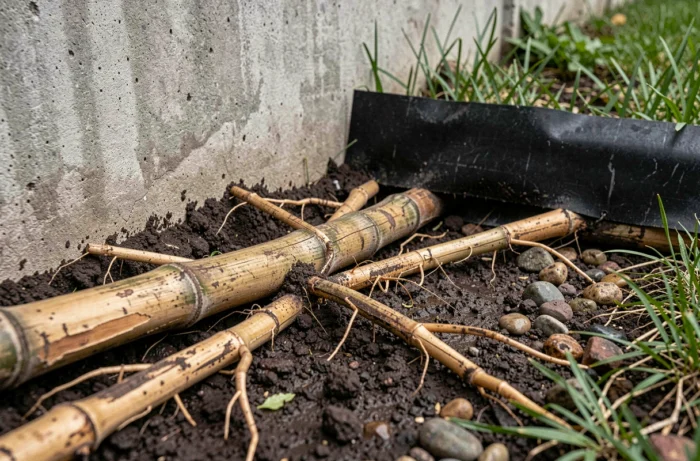
The distinction between spreading bamboo and clumping bamboo determines the level of legal risk. Spreading species (Phyllostachys, Pseudosasa) develop underground rhizomes capable of advancing several meters per season. Even when respecting the regulatory distance of 2 meters, these rhizomes can cross the property line without the owner noticing.
We observe a legal point often misunderstood by individuals. The neighbor whose land is invaded has the right to cut the rhizomes at the property line themselves, without prior notice. In contrast, the overhanging aerial parts cannot be cut without notice to the bamboo owner. This asymmetry, stemming from Article 673 of the Civil Code, often generates confusion in neighborhood disputes.
The question of legislation on bamboo planting is therefore not limited to respecting distances. It imposes a continuous vigilance obligation regarding the underground behavior of the plant.
Abnormal Neighborhood Disturbance and Bamboo: What the Judge Specifically Orders
The law of April 15, 2024, integrated into Article 1253 of the Civil Code, has codified abnormal neighborhood disturbance. For bamboo, this codification strengthens the position of the invaded neighbor: they no longer need to prove fault, only the abnormality of the disturbance suffered.
A ruling from the Court of Cassation on October 10, 2019, had already set a precedent. The case law confirms that bamboo rhizomes can justify heavy measures imposed by the judge:
- The installation of an anti-rhizome barrier at the expense of the bamboo owner, along the entire length of the property line
- The restoration of the neighbor’s land, including the removal of rhizomes and the repair of damaged surfaces (pavings, pipelines)
- In the most serious cases, demolition work when the rhizomes have reached foundations or buried networks
We recommend not to neglect the evidentiary aspect. An interim ruling from July 30, 2026, reminds us that a judicial expertise can be ordered before any substantive trial to assess the extent of the root invasion. The cost of this expertise, which may initially be borne by the plaintiff, serves as leverage in amicable negotiations.
Local Practices and Specific Regulations: Check Before Planting
Article 671 of the Civil Code does not apply uniformly. Local practices or specific regulations may set distances higher or lower than the legal thresholds. Some municipalities impose stricter distances for species deemed invasive.
The preliminary step before any bamboo planting at the property line goes through the town hall. The local urban planning plan (PLU) may contain specific provisions on the plant species allowed at the property line, even prohibiting certain spreading species in dense residential areas.
The absence of verification of local practices is not a valid excuse before the judge. An owner who plants a spreading bamboo at the minimum distance of the Civil Code, while a local practice required a greater distance, risks a complete uprooting.

Anti-Rhizome Barrier: Obligation of Means or Simple Precaution
The installation of an anti-rhizome barrier before planting is not a legal obligation as such. No text explicitly requires it. However, its absence systematically works against the owner in case of a dispute.
The judge assesses the planter’s behavior in light of the general obligation not to harm others. Planting a Phyllostachys without an anti-rhizome barrier 2 meters from a property line is to knowingly create a risk of encroachment. The installation of a sufficiently deep anti-rhizome barrier constitutes the best proof of diligence in case of litigation.
The barrier should be buried vertically along the boundary, at a depth suitable for the species (Phyllostachys rhizomes generally circulate in the top decimeters of soil but can go deeper in loose terrain). It should slightly exceed the surface to prevent crossing from above.
Clumping Bamboo at the Property Line: An Alternative That Reduces Legal Risk
The choice of clumping species (Fargesia, Bambusa for mild climate regions) radically changes the situation. These bamboos form compact clumps without spreading rhizomes. The risk of encroachment on the neighbor becomes almost nonexistent.
The planting distances remain the same: 2 meters if the height exceeds 2 meters, 50 centimeters below. But the probability of disputes drops significantly. A properly contained clumping bamboo does not generate abnormal neighborhood disturbance.
This substitution strategy is all the more relevant as some Fargesia species reach sufficient heights to provide effective screening, while still respecting regulatory thresholds if the planting distance is appropriate.
The choice between spreading and clumping bamboo is not just horticultural. It is a decision that engages the civil liability of the owner in the long term, well beyond the simple question of regulatory distance.